
Ask the Experts
From the end of the Second World War through the U.S. Bicentennial, the National Endowment for the Arts, the Rockefeller Foundation, and the Ford Foundation granted close to $300 million (approximately $2.3 billion in 2017 dollars) in the field of music alone. In deciding what to fund, these three grantmaking institutions decided to "ask the experts," adopting seemingly objective, scientific models of peer review and specialist evaluation. They recruited music composers at elite institutions, professors from prestigious universities, and leaders of performing arts organizations. Among the most influential expert-consultants were Leonard Bernstein, Aaron Copland, Lukas Foss, and Milton Babbitt.
The significance was two-fold: not only were male, Western art composers put in charge of directing large and unprecedented channels of public and private funds, but in doing so they also determined and defined what was meant by artistic excellence. They decided the fate of their peers and shaped the direction of music-making in this country. By asking the experts, the grantmaking institutions produced a concentrated and interconnected field of artists and musicians. Officers and directors utilized ostensibly objective financial tools like matching grants and endowments in an attempt to diversify and stabilize applicants' sources of funding, as well as the number of applicants they funded. Such economics-based strategies, however, relied more on personal connections among the wealthy and elite, rather than local community citizens.
“After all my years and experiences leading institutions, Ask the Experts still gives me new insights in the art of grantmaking. As Uy notes, how we choose experts plays an incredibly important role in what we fund. Experts should broaden and even challenge our perspectives and starting assumptions rather than only reinforce them.”
“Uy’s disarming narrative propels the reader through a series of interwoven stories about cultural and social capital during the first decades of the Cold War and the illusion of democratic representation in arts grantmaking. With helpful charts, tables, and spotlights on influential experts, this book provides a useful guide with the ease of a textbook.”
“Ask the Experts makes painfully vivid the practices of power and exclusion behind grant-making decisions by white men invested in the Western art music tradition. Uy’s meticulously researched and lively account illuminates the biased processes that determined which institutions would call the shots and what music should be validated. A book for our times.”
Ultimately, this history demonstrates how "expertise" served as an exclusionary form of cultural and social capital that prevented racial minorities and non-dominant groups from fully participating.
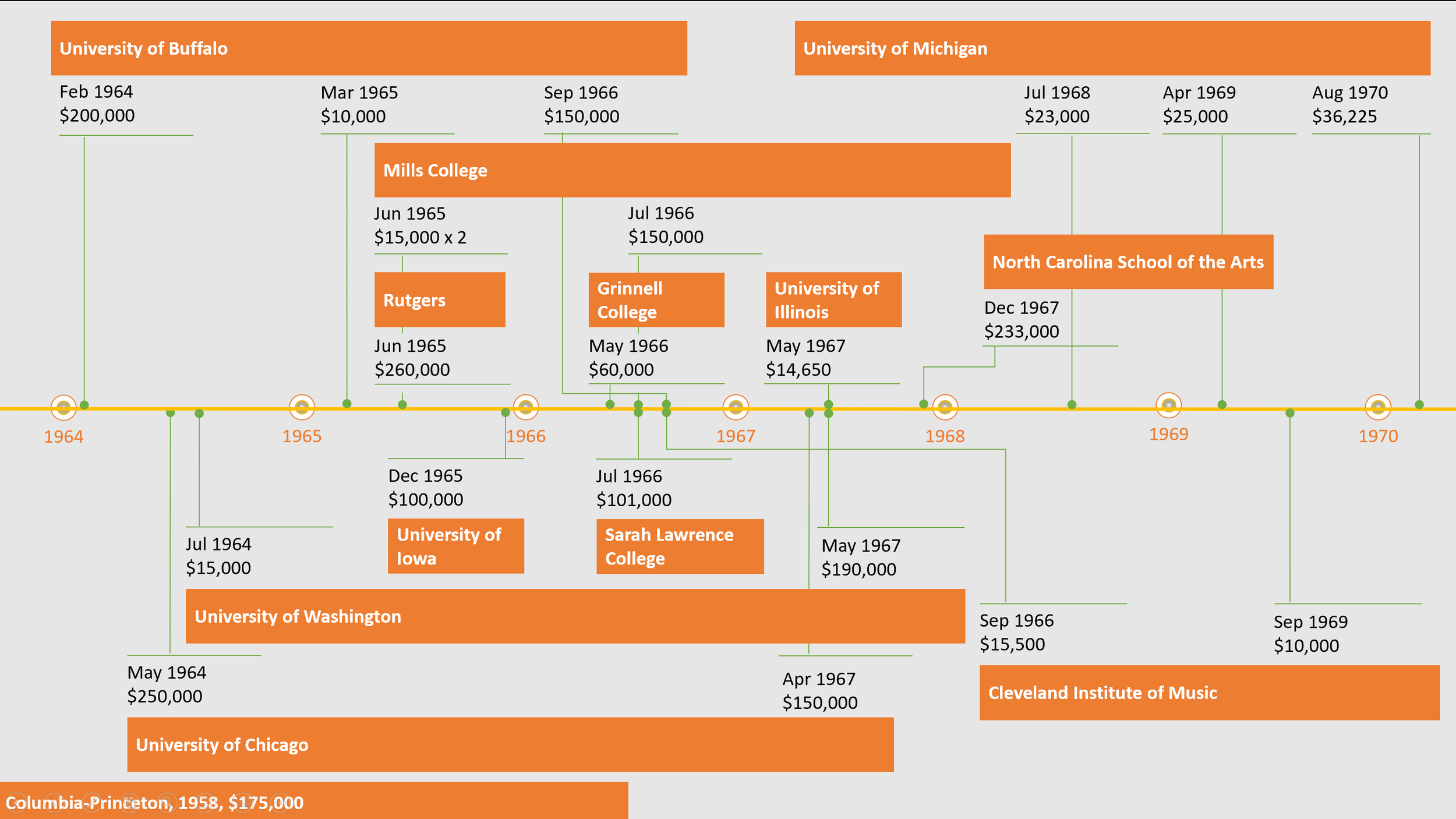
From the late 1950s to 1970s, the Rockefeller Foundation supported university new music centers and contemporary chamber ensembles. The experimental groups and electronic music composers solidified a circuit that crisscrossed the country, from Columbia and Princeton to the University of Chicago and Mills College, making stops at many Rockefeller-funded centers.
I fully recognize that OUP has priced this book beyond the means of most readers. Please read the Executive Summary or reach out to me via the “contact” section.
The book can also be purchased through other vendors.
In 2020 I committed to donating 100% of author royalties to Black Lives Matter, the NAACP Legal Defense and Educational Fund, and the Asian American Legal Defense and Education Fund. In complete transparency, my royalties are only 5% of net receipts, and I continue to make other monetary contributions. I am fortunate to have the job security, housing security, food security, and racial privilege to make these donations, while acknowledging that not all are in a position to do so.